
The API requests log
The webhooks Sync Pro received for your team, stored as they arrived, what is not kept there, and the action that runs one again when something did not land.
What reaches Sync Pro from outside — a WhatsApp message or a delivery update from Meta, a finished call from Callpicker — arrives as a webhook. When the webhook belongs to your team, it is stored before it is processed. Api Requests, in the team menu, is that log, newest first.
You see it when your role has See on the Api Request row of the Roles screen. See Roles and permissions.
This is the screen to open when someone says "the message never arrived".
What a record holds
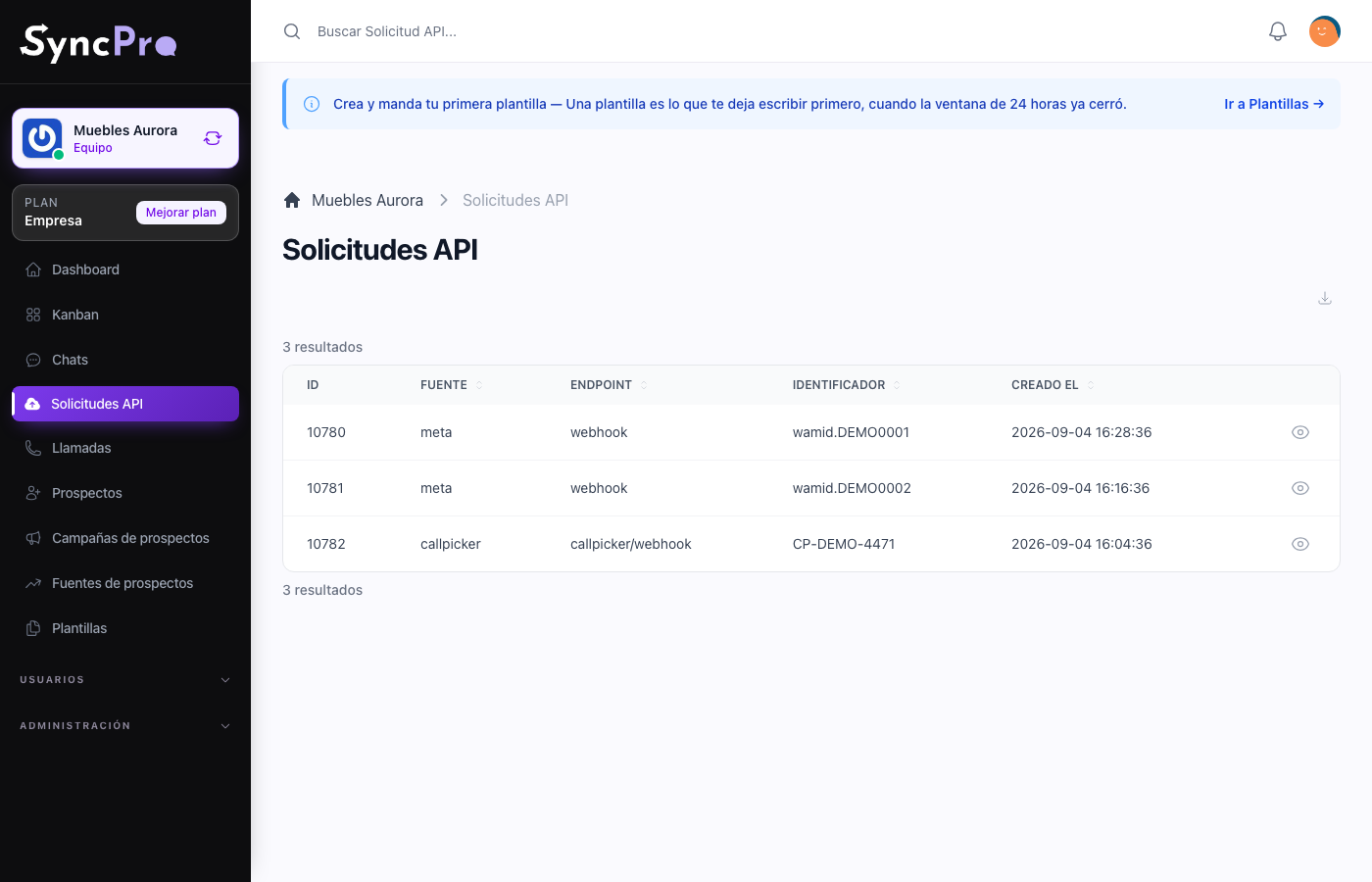
| Field | What it tells you |
|---|---|
| Source | Who sent it: whatsapp for Meta, callpicker for Callpicker. |
| Endpoint | Which address it arrived at. |
| Identifier | The reference the sender used, for matching against their own logs. Callpicker records carry the call's id; WhatsApp records leave it empty. |
| Request | The full payload, exactly as it was received, as JSON. It is shown when you open the record. |
| Created At | When it arrived. |
The payload is the useful part. It is what the sender actually sent, not Sync Pro's interpretation of it, which is what makes it possible to tell the two apart.
What is not in your log
Not every webhook ends up in your team's log:
- Template status changes. When Meta approves, rejects or pauses a template, Sync Pro updates the template but keeps no record of the webhook.
- Messages for a number that is not linked to your team. A webhook for a number that no team has fully linked is stored without a team, so it does not appear in any team's log. That includes your own number while it is linked but not confirmed, or after it was disconnected. A WhatsApp webhook that does not say which number it is for is kept the same way, outside every team's log.
- Webhooks Sync Pro cannot read. A body that is not JSON, or one without the part that says what changed, is answered and dropped without a record.
- Callpicker calls without the Callpicker module. When your team does not have the module, Callpicker's webhook is refused and nothing is stored.
- The same Callpicker call sent twice. Callpicker records are matched by the call's id, so a call that arrives again keeps its first record and no second one is added. It is still processed again, as when you run one again.
Reading it when something is missing
The question the log answers first is which of two things happened:
- There is no record. Usually the webhook never arrived, and the problem is outside Sync Pro: for Callpicker, the address is not configured there or points somewhere else; for WhatsApp with token access, the webhook is not set in your Meta app. Before concluding that, rule out the cases in What is not in your log — a number that is not fully linked to your team is the common one. Check the WhatsApp module or the Callpicker module.
- There is a record but nothing happened. The webhook arrived and processing it did not produce what you expected. The payload tells you what it actually contained.
Running one again
Each record has the Execute Api Request action, which sends the stored payload to Sync Pro again, exactly as it arrived. It is the fix for the case where a webhook came in while something was misconfigured: correct the configuration, then run the request again rather than asking the sender to resend it.
It does real work, so run the one you mean. What it does depends on the source:
- WhatsApp. The run arrives as a new webhook, so it adds a new record to the log. A message that was already received is not duplicated in the chat. If ChatGPT answers that contact automatically, it answers that message again.
- Callpicker. No new record is added. With the Assembly AI module connected, a call that was already recorded is not duplicated: Sync Pro only asks Assembly AI for its analysis again. Without Assembly AI, every run records the call again, and the call appears twice.
What it is not
It is not an outgoing API for your own systems, and it is not a place to send requests from. It is the record of what arrived.